Crabronidae
| Crabronidae | |
|---|---|
 | |
Tachysphex sp. | |
Scientific classification  | |
| Kingdom: | Animalia |
| Phylum: | Euarthropoda |
| Class: | Insecta |
| Order: | Hymenoptera |
| Superfamily: | Apoidea |
| Family: | Crabronidae Latreille, 1802 |
| Subfamilies | |
Astatinae | |
The Crabronidae are a large paraphyletic group (nominally a family) of wasps, including nearly all of the species formerly comprising the now-defunct superfamily Sphecoidea. It collectively includes well over 200 genera, containing well over 9000 species. Crabronids were originally a part of Sphecidae, but the latter name is now restricted to a separate family based on what was once the subfamily Sphecinae. As this change is very recent, the subfamilies of Crabronidae likely will each eventually be treated as families in their own right, as they have been treated as such by many authorities in the past (as in the catalog linked below).
Contents
1 Phylogeny
2 Subgroups
3 See also
4 References
5 Sources
6 External links
Phylogeny
This phylogenetic tree is based on Sann et al., 2018, which used phylogenomics to demonstrate that both the bees (Anthophila) and the Sphecidae arose from within the former Crabronidae, which is therefore paraphyletic, and which they suggested should be split into several families; the former family Heterogynaidae nests within the Bembicidae, as here defined.[1] These findings differ in several details from studies published by two other sets of authors in 2017, though all three studies demonstrate a paraphyletic "Crabronidae."[2][3] Only three of these lineages were not included within Crabronidae in the past: Ampulicidae, Sphecidae, and Anthophila.
.mw-parser-output table.clade{border-spacing:0;margin:0;font-size:100%;line-height:100%;border-collapse:separate;width:auto}.mw-parser-output table.clade table.clade{width:100%}.mw-parser-output table.clade td{border:0;padding:0;vertical-align:middle;text-align:center}.mw-parser-output table.clade td.clade-label{width:0.8em;border:0;padding:0 0.2em;vertical-align:bottom;text-align:center}.mw-parser-output table.clade td.clade-slabel{border:0;padding:0 0.2em;vertical-align:top;text-align:center}.mw-parser-output table.clade td.clade-bar{vertical-align:middle;text-align:left;padding:0 0.5em}.mw-parser-output table.clade td.clade-leaf{border:0;padding:0;text-align:left;vertical-align:middle}.mw-parser-output table.clade td.clade-leafR{border:0;padding:0;text-align:right}
| Apoidea |
| ||||||||||||||||||||||||||||||||||||||||||||||||||||||||||||||||||
| |
Subgroups
- Subfamily Astatinae
Astata, etc.
- Subfamily Bembicinae
- Tribe Alyssontini
- Tribe Bembicini
Bembix Fabricius 1775
Zyzzyx Pate 1937, etc.
- Tribe Gorytini
Gorytes Latreille, 1804
Sphecius, etc.
- Tribe Heliocausini
- Tribe Nyssonini
- Tribe Stizini
- Tribe Alyssontini
- Subfamily Crabroninae (incl. Eremiaspheciinae and Dinetinae)
- Crabro
- Aha
- Dalara
Pison, etc.
- Subfamily Mellininae
- Mellinus
- Xenosphex
- Subfamily Pemphredoninae
- Microstigmus
- Lithium
Pemphredon, etc.
- Subfamily Philanthinae
- Cerceris
Philanthus, etc.
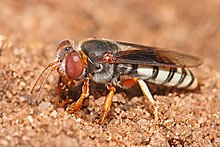
Sand wasp in its habitat, Dar es Salaam, Tanzania
See also
- List of Crabronidae genera
References
^ Sann, Manuela; Niehuis, Oliver; Peters, Ralph S.; Mayer, Christoph; Kozlov, Alexey; Podsiadlowski, Lars; Bank, Sarah; Meusemann, Karen; Misof, Bernhard; Bleidorn, Christoph; Ohl, Michael (2018). "Phylogenomic analysis of Apoidea sheds new light on the sister group of bees". BMC Evolutionary Biology. 18: 71. doi:10.1186/s12862-018-1155-8..mw-parser-output cite.citation{font-style:inherit}.mw-parser-output q{quotes:"""""""'""'"}.mw-parser-output code.cs1-code{color:inherit;background:inherit;border:inherit;padding:inherit}.mw-parser-output .cs1-lock-free a{background:url("//upload.wikimedia.org/wikipedia/commons/thumb/6/65/Lock-green.svg/9px-Lock-green.svg.png")no-repeat;background-position:right .1em center}.mw-parser-output .cs1-lock-limited a,.mw-parser-output .cs1-lock-registration a{background:url("//upload.wikimedia.org/wikipedia/commons/thumb/d/d6/Lock-gray-alt-2.svg/9px-Lock-gray-alt-2.svg.png")no-repeat;background-position:right .1em center}.mw-parser-output .cs1-lock-subscription a{background:url("//upload.wikimedia.org/wikipedia/commons/thumb/a/aa/Lock-red-alt-2.svg/9px-Lock-red-alt-2.svg.png")no-repeat;background-position:right .1em center}.mw-parser-output .cs1-subscription,.mw-parser-output .cs1-registration{color:#555}.mw-parser-output .cs1-subscription span,.mw-parser-output .cs1-registration span{border-bottom:1px dotted;cursor:help}.mw-parser-output .cs1-hidden-error{display:none;font-size:100%}.mw-parser-output .cs1-visible-error{font-size:100%}.mw-parser-output .cs1-subscription,.mw-parser-output .cs1-registration,.mw-parser-output .cs1-format{font-size:95%}.mw-parser-output .cs1-kern-left,.mw-parser-output .cs1-kern-wl-left{padding-left:0.2em}.mw-parser-output .cs1-kern-right,.mw-parser-output .cs1-kern-wl-right{padding-right:0.2em}
^ Branstetter, Michael G.; Danforth, Bryan N.; Pitts, James P.; Faircloth, Brant C.; Ward, Philip S.; Buffington, Matthew L.; Gates, Michael W.; Kula, Robert R.; Brady, Seán G. (2017). "Phylogenomic Insights into the Evolution of Stinging Wasps and the Origins of Ants and Bees". Current Biology. 27 (7): 1019–1025. doi:10.1016/j.cub.2017.03.027.
^ Peters, Ralph S.; Krogmann, Lars; Mayer, Christoph; Donath, Alexander; Gunkel, Simon; Meusemann, Karen; Kozlov, Alexey; Podsiadlowski, Lars; Petersen, Malte. "Evolutionary History of the Hymenoptera". Current Biology. 27 (7): 1013–1018. doi:10.1016/j.cub.2017.01.027.
Sources
- Catalog of Sphecidae sensu lato at Cal Academy
External links
 | Wikimedia Commons has media related to Crabronidae. |
- Image Gallery from Gembloux
Larra spp., mole cricket hunters on the UF / IFAS Featured Creatures Web site
| Topics |
|  |
|---|---|---|
| Groups |
| |
| In culture |
| |
| Pioneers, works |
| |
 | This Apoidea-related article is a stub. You can help Wikipedia by expanding it. |


